> ## Documentation Index
> Fetch the complete documentation index at: https://docs.nextlevelmca.com/llms.txt
> Use this file to discover all available pages before exploring further.
# How do deals move through the pipeline?
> Stages and phases, moving a deal by hand, who owns a deal, tasks, notes, the activity log, paper grade and matching inputs.
Every deal sits in one pipeline stage. This article covers how stages work, how to move a deal yourself, and the parts of a deal you use to work it: owners, tasks, notes, the activity log, the paper grade and the matching inputs. Anyone who can edit deals can move them. Changing the stages themselves needs Settings access.
## Stages and phases
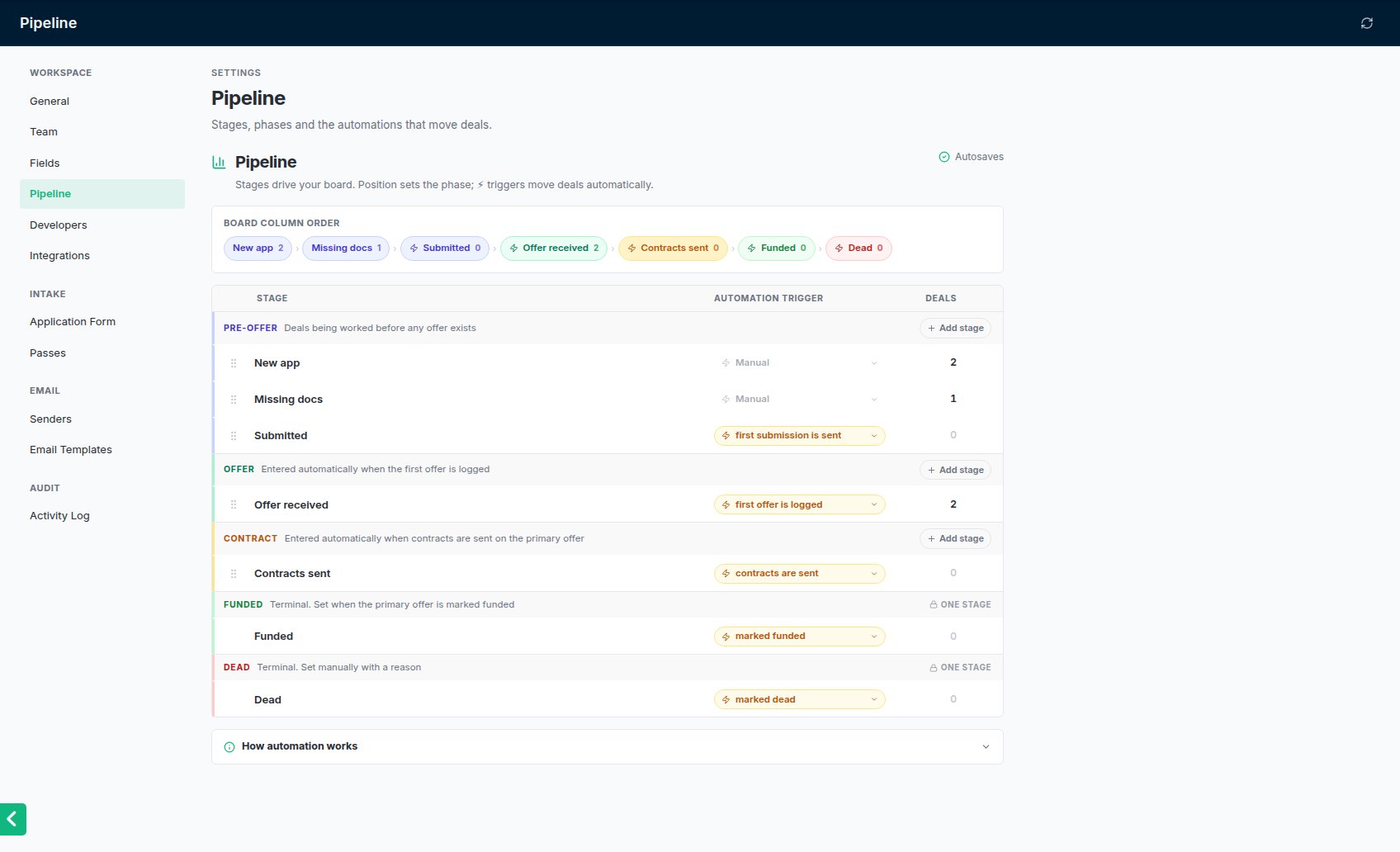
Your stages live under **Settings → Pipeline**. Every stage belongs to one of five phases, always in this order:
| Phase | Meaning | Default stages |
| - | - | - |
| Pre-offer | Collecting documents and submitting | New app, Missing docs, Submitted |
| Offer | At least one lender has made an offer | Offer received |
| Contract | The merchant accepted and contracts are in motion | Contracts sent |
| Funded | Money went out and an advance exists | Funded |
| Dead | Closed without funding | Dead |
Funded and Dead always have exactly one stage each. In the other phases you can rename, reorder, recolour and add stages.
A new deal starts in the first stage of the Pre-offer phase (**New app** by default). See [Creating a deal](/help/create-deal).
 ## Finding deals
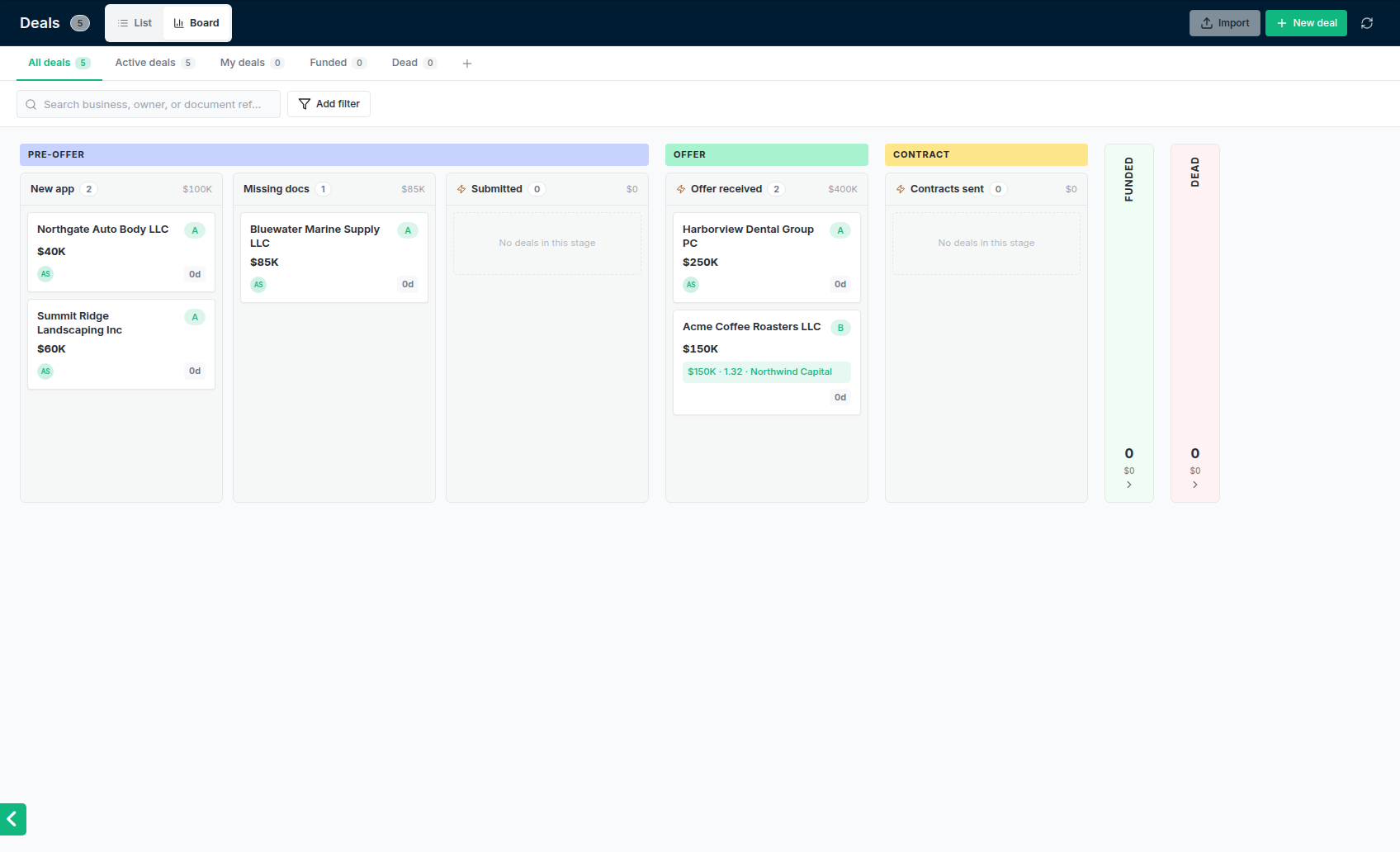
The **Deals** page has two views: **List** and **Board**. The board has one column per stage, grouped by phase, with the primary offer on the card once there is one.
The tabs across the top are saved lists: **All deals**, **Active deals**, **My deals**, **Unassigned**, **Funded** and **Dead**, plus any lists your team saves. What "All deals" covers depends on your role; see [Record visibility](/help/record-visibility). Search finds a deal by business, owner or document reference.
## Finding deals
The **Deals** page has two views: **List** and **Board**. The board has one column per stage, grouped by phase, with the primary offer on the card once there is one.
The tabs across the top are saved lists: **All deals**, **Active deals**, **My deals**, **Unassigned**, **Funded** and **Dead**, plus any lists your team saves. What "All deals" covers depends on your role; see [Record visibility](/help/record-visibility). Search finds a deal by business, owner or document reference.
 ### Acting on several deals at once
In the **List** view, tick deals to open the action bar at the bottom of the page:
* **Assign rep** sets the originator, the closer or both on every selected deal. **Leave as is** keeps each deal's own. Reps can assign deals only to themselves, and managers only to their team.
* **Export** downloads the selected deals as a CSV.
* **Delete** deletes the selected deals for good. Deals that can't be deleted are kept and listed with the reason (see [Deleting a deal](#deleting-a-deal)).
**Add tag**, **Add to workflow**, **Send SMS** and **Send email** are coming soon.
## Moving a deal by hand
On the **Board**, drag the card to another column. Or open the deal and click the stage bar under the header, which opens **Move stage**.
**Move stage** has a **Reason / note** box. It's optional, except when you move a deal to Dead.
Click **Move stage**. A manual move can go forwards or backwards.
Some stages don't accept a manual move:
* **Stages set by an event.** A stage bound to an event such as *first submission sent*, *first offer logged* or *contracts sent* only receives deals from that event. On the board a drop is refused with **Automated stage**, and in **Move stage** the stage is greyed out with *set by workflow*. Do the thing itself (submit, log the offer, send contracts) and the deal moves on its own. See [Pipeline stage events](/help/pipeline-stage-events).
* **Funded.** A deal only reaches Funded when you mark an offer as funded, because that creates the advance. Dragging a card to Funded opens the deal and reminds you to do that. See [Marking a deal funded](/help/mark-funded).
* **Dead** always needs a reason. Dragging to Dead opens **Mark as dead**, where you pick a reason (such as *Merchant unresponsive* or *Declined by all lenders*) and can add a note. Moving a deal to Dead, by dragging or with **Move stage**, closes the deal out. Moving a closed-out deal to any other stage reopens it.
* **A funded deal can't go to Dead.** Once a deal has an advance, the money went out, so Dead is greyed out in **Move stage** and a drop on Dead is refused.
The deal's **More** menu (the **…** button in the header) also has **Close out deal**, which moves the deal to Dead, and **Reopen deal** for a deal that was closed out. Funded deals don't have **Close out deal**. Reopening works out the right stage again from the deal's submissions, offers and funding.
Every move, manual or automatic, is recorded in the deal's activity log with who made it.
## Who owns the deal
Each deal has an **Originator** (who brought it in) and a **Closer** (who is working it). Both show as chips in the deal header: click one to change it. Whoever creates a deal becomes its originator unless someone else is chosen. The merchant sees both names on the [merchant portal](/help/merchant-portal).
Emails the app sends automatically for a deal go from the closer's mailbox, then the originator's, then the mailbox of whoever created the deal, then the workspace default. See [Default sender](/help/default-sender).
If your workspace uses automatic passes (**Settings → Passes**), an approved deal the original rep doesn't fund can pass to the next rep in the rotation.
## Deleting a deal
**Delete deal** is in the deal's **More** menu (the **…** button), and **Delete** is in the list's action bar. Both need the **Delete** permission on deals. Deleting is permanent: the deal's documents, notes and history go with it. The business and its CRM contact stay.
To protect your records, some deals can't be deleted:
* **Funded deals**, meaning any deal with an advance or a Lender or Rep Commission. Deleting would erase money records.
* **Deals submitted to a lender**, by email or by API, and **deals with offers**. The lender already has the file.
For a deal that was submitted or has offers, use **Close out deal** instead. It moves the deal to Dead and keeps everything. A funded deal stays in Funded.
## Tasks, notes and the activity log
These are tabs on the deal.
* **Tasks** are follow-ups. Click **New task**, say what needs to happen, and optionally set a due date and an assignee. Tick a task to complete it. The tab badge counts open tasks.
* **Notes** are internal: the merchant never sees them. Tick **Pin to top** to keep one above the rest. You can edit, pin, unpin or delete a note later.
* **Activity log** is everything that happened on the deal: field changes, emails, submissions, offers, documents, stage moves and what the merchant did in the portal, with who did it and when. You can search it, filter by person and **Export** it. Entries are never edited or removed. This tab only shows for people whose role includes viewing logs.
## Paper grade
Every deal gets a paper grade from **A** to **D** once its bank statements have been analyzed. Until then it has none. The grade starts from 100 points and loses points for NSFs, negative days, existing positions, short time in business, low monthly revenue, low average balance, a high share of revenue going to existing advances, recovery activity and, when known, a low credit score. 80 or more is A, 60 or more is B, 40 or more is C, anything lower is D.
You see the grade on the deal list (and can filter by it), on the **Submissions** tab, and in lender matching, where lenders can say which grades they take. Hover the grade on the Submissions tab to see what cost it points.
To set it yourself, open **Matching inputs** on the Submissions tab and pick a grade under **Paper grade**. A grade you set is marked *manual* and is never overwritten. Pick **Computed** to go back to the worked-out grade.
## Matching inputs
On the **Submissions** tab, the **Matching inputs** card holds facts the lender matching can't read from documents. Click the arrow to open it:
* **Product**: MCA, term loan, line of credit, equipment, factoring or reverse consolidation
* **Desired term** in months and **Desired frequency** (daily, weekly, bi-weekly, monthly)
* **Paper grade** override
* **Bankruptcy** (how many months ago) and **Franchise** (how many years)
* **Prior MCA default**, **ACH reversals** and **Seasonal business**
Each field saves as you change it, and every lender's score updates. Only your team sees these; nothing here is asked of the merchant. See [Match score](/help/match-score).
## Related
* [Creating a deal](/help/create-deal)
* [Pipeline stage events](/help/pipeline-stage-events)
* [Marking a deal funded](/help/mark-funded)
* [Record visibility](/help/record-visibility)
This documentation is built and hosted on [Mintlify](https://mintlify.com), a developer documentation platform.
### Acting on several deals at once
In the **List** view, tick deals to open the action bar at the bottom of the page:
* **Assign rep** sets the originator, the closer or both on every selected deal. **Leave as is** keeps each deal's own. Reps can assign deals only to themselves, and managers only to their team.
* **Export** downloads the selected deals as a CSV.
* **Delete** deletes the selected deals for good. Deals that can't be deleted are kept and listed with the reason (see [Deleting a deal](#deleting-a-deal)).
**Add tag**, **Add to workflow**, **Send SMS** and **Send email** are coming soon.
## Moving a deal by hand
On the **Board**, drag the card to another column. Or open the deal and click the stage bar under the header, which opens **Move stage**.
**Move stage** has a **Reason / note** box. It's optional, except when you move a deal to Dead.
Click **Move stage**. A manual move can go forwards or backwards.
Some stages don't accept a manual move:
* **Stages set by an event.** A stage bound to an event such as *first submission sent*, *first offer logged* or *contracts sent* only receives deals from that event. On the board a drop is refused with **Automated stage**, and in **Move stage** the stage is greyed out with *set by workflow*. Do the thing itself (submit, log the offer, send contracts) and the deal moves on its own. See [Pipeline stage events](/help/pipeline-stage-events).
* **Funded.** A deal only reaches Funded when you mark an offer as funded, because that creates the advance. Dragging a card to Funded opens the deal and reminds you to do that. See [Marking a deal funded](/help/mark-funded).
* **Dead** always needs a reason. Dragging to Dead opens **Mark as dead**, where you pick a reason (such as *Merchant unresponsive* or *Declined by all lenders*) and can add a note. Moving a deal to Dead, by dragging or with **Move stage**, closes the deal out. Moving a closed-out deal to any other stage reopens it.
* **A funded deal can't go to Dead.** Once a deal has an advance, the money went out, so Dead is greyed out in **Move stage** and a drop on Dead is refused.
The deal's **More** menu (the **…** button in the header) also has **Close out deal**, which moves the deal to Dead, and **Reopen deal** for a deal that was closed out. Funded deals don't have **Close out deal**. Reopening works out the right stage again from the deal's submissions, offers and funding.
Every move, manual or automatic, is recorded in the deal's activity log with who made it.
## Who owns the deal
Each deal has an **Originator** (who brought it in) and a **Closer** (who is working it). Both show as chips in the deal header: click one to change it. Whoever creates a deal becomes its originator unless someone else is chosen. The merchant sees both names on the [merchant portal](/help/merchant-portal).
Emails the app sends automatically for a deal go from the closer's mailbox, then the originator's, then the mailbox of whoever created the deal, then the workspace default. See [Default sender](/help/default-sender).
If your workspace uses automatic passes (**Settings → Passes**), an approved deal the original rep doesn't fund can pass to the next rep in the rotation.
## Deleting a deal
**Delete deal** is in the deal's **More** menu (the **…** button), and **Delete** is in the list's action bar. Both need the **Delete** permission on deals. Deleting is permanent: the deal's documents, notes and history go with it. The business and its CRM contact stay.
To protect your records, some deals can't be deleted:
* **Funded deals**, meaning any deal with an advance or a Lender or Rep Commission. Deleting would erase money records.
* **Deals submitted to a lender**, by email or by API, and **deals with offers**. The lender already has the file.
For a deal that was submitted or has offers, use **Close out deal** instead. It moves the deal to Dead and keeps everything. A funded deal stays in Funded.
## Tasks, notes and the activity log
These are tabs on the deal.
* **Tasks** are follow-ups. Click **New task**, say what needs to happen, and optionally set a due date and an assignee. Tick a task to complete it. The tab badge counts open tasks.
* **Notes** are internal: the merchant never sees them. Tick **Pin to top** to keep one above the rest. You can edit, pin, unpin or delete a note later.
* **Activity log** is everything that happened on the deal: field changes, emails, submissions, offers, documents, stage moves and what the merchant did in the portal, with who did it and when. You can search it, filter by person and **Export** it. Entries are never edited or removed. This tab only shows for people whose role includes viewing logs.
## Paper grade
Every deal gets a paper grade from **A** to **D** once its bank statements have been analyzed. Until then it has none. The grade starts from 100 points and loses points for NSFs, negative days, existing positions, short time in business, low monthly revenue, low average balance, a high share of revenue going to existing advances, recovery activity and, when known, a low credit score. 80 or more is A, 60 or more is B, 40 or more is C, anything lower is D.
You see the grade on the deal list (and can filter by it), on the **Submissions** tab, and in lender matching, where lenders can say which grades they take. Hover the grade on the Submissions tab to see what cost it points.
To set it yourself, open **Matching inputs** on the Submissions tab and pick a grade under **Paper grade**. A grade you set is marked *manual* and is never overwritten. Pick **Computed** to go back to the worked-out grade.
## Matching inputs
On the **Submissions** tab, the **Matching inputs** card holds facts the lender matching can't read from documents. Click the arrow to open it:
* **Product**: MCA, term loan, line of credit, equipment, factoring or reverse consolidation
* **Desired term** in months and **Desired frequency** (daily, weekly, bi-weekly, monthly)
* **Paper grade** override
* **Bankruptcy** (how many months ago) and **Franchise** (how many years)
* **Prior MCA default**, **ACH reversals** and **Seasonal business**
Each field saves as you change it, and every lender's score updates. Only your team sees these; nothing here is asked of the merchant. See [Match score](/help/match-score).
## Related
* [Creating a deal](/help/create-deal)
* [Pipeline stage events](/help/pipeline-stage-events)
* [Marking a deal funded](/help/mark-funded)
* [Record visibility](/help/record-visibility)
This documentation is built and hosted on [Mintlify](https://mintlify.com), a developer documentation platform.